Balance Exercises for Seniors: A Progressive Guide
Balance exercises for seniors 65+, organized from beginner to advanced, with clear form cues and how to progress safely as your stability improves.
Why Balance Training Matters More With Age
Balance is a trainable skill, not a fixed trait — but it does decline with age if it isn’t actively maintained, largely because we stop challenging it in daily life. The payoff for training it deliberately is significant: better balance supports confidence on stairs, uneven sidewalks, and getting in and out of a car or shower, and it’s one of the most direct ways to support long-term independence.
This guide organizes balance work from beginner to more advanced, so you can start where you actually are and progress as your stability builds. As always, check with your doctor before starting a new routine, have a sturdy chair or counter nearby for support, and stop if anything causes pain or genuine unsteadiness.
Beginner: Building a Foundation
Weight shifts. Standing with feet hip-width apart, holding a counter if needed, slowly shift your weight onto one foot, hold 3–5 seconds, then shift to the other. 8–10 shifts per side. This teaches your body to feel and control weight distribution.
Seated-to-standing. From a chair, stand up without using your hands if possible, pause, then sit back down with control. 8–10 reps. This is one of the most functional balance-and-strength movements there is — it’s balance training and strength training at once.
Marching in place. Holding support, lift one knee to hip height, lower, then the other. 20 alternating lifts. This builds single-leg stability in a controlled, low-risk way.
Intermediate: Reducing Support
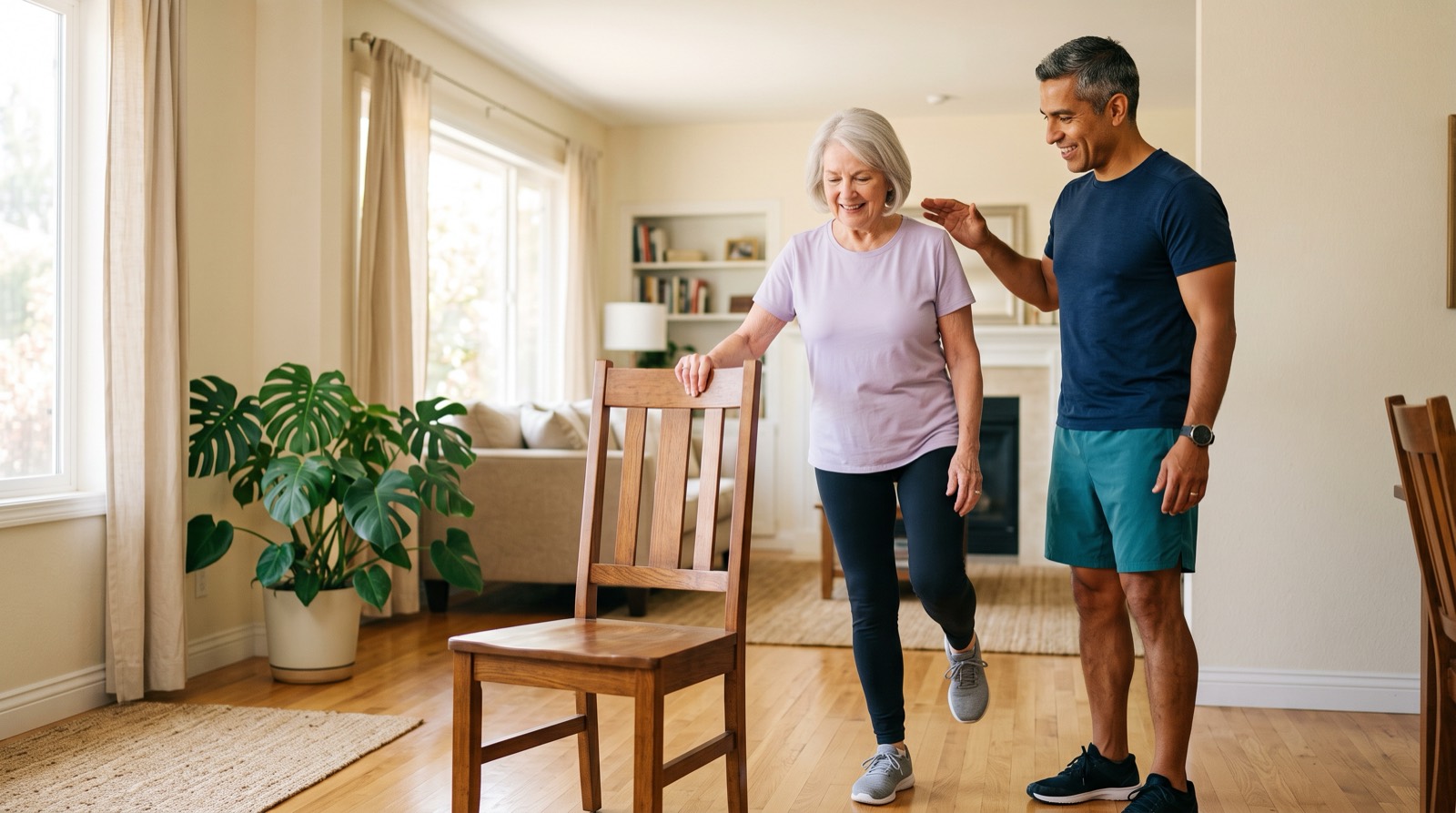
Single-leg stand (supported). Holding a counter with one hand, lift one foot slightly off the floor and hold. Start with 10–15 seconds per side, working toward 30 seconds as it gets easier.
Heel-to-toe walk. Walk in a straight line placing the heel of one foot directly in front of the toes of the other, using a wall for light support if needed. 10–15 steps.
Standing on an unstable-but-safe surface, like a folded towel or a foam pad, while holding support. This adds a small, controlled challenge to the same weight-shift skills from the beginner stage.
Advanced: Removing Support
Single-leg stand (unsupported). The same movement as above, but without holding on — only progress here once the supported version feels genuinely solid, not just tolerable.
Single-leg stand with head turns. While balancing on one leg, slowly turn your head side to side. This trains balance under a more realistic, distracted condition — much closer to how balance actually gets tested in daily life.
Tandem stance with eyes closed (briefly, with a spotter or wall nearby). This removes visual input, forcing the inner ear and body awareness to do more of the work. Only attempt this with something solid within reach.
How to Progress Safely
Move to the next level only when the current one feels stable and unremarkable — not just “doable.” Rushing progression is the most common mistake; the goal is genuine control at each stage, not just getting through the reps.
Where a Trainer Fits
Balance work is one of the areas where in-person feedback matters most — a trainer can spot small compensations (leaning, gripping too hard, holding your breath) that are hard to catch on your own, and structure the right progression pace for your starting point, with a 100% right form and technique focus throughout.
Saul holds a Seniors Training Certification and builds balance progressions into every senior program, in person in Miami or through online coaching. For a lower-impact starting point, see seated chair exercises for seniors. Learn more about senior personal training in Miami, or book a free consultation.